
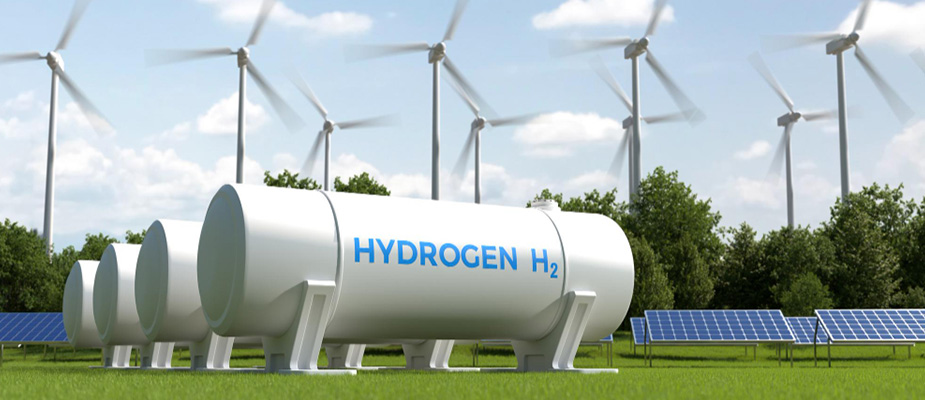
The hydrogen economy is rapidly emerging as one of the most significant areas of attention for a global society that is looking to transition to a decarbonised future, and hydrogen has been hailed as the “holy grail” of clean energy. Specifically, there is a large amount of momentum building around hydrogen development in India through the National Green Hydrogen Mission, which anticipates reaching a production capacity of 5 million metric tonnes per year by 2030. If successful, this will position India as a major player in the global hydrogen economy.
However, the challenges associated with hydrogen do not end with the production of green hydrogen. The real challenge lies in finding effective means of storing, transporting and utilising hydrogen.
Hydrogen gas storage will play an essential role in achieving a decarbonised economy. It is important to note that due to hydrogen’s status as the lightest element in the universe, it will have a high energy content by weight but a very low energy density as a substance (i.e., as a liquid or gas). Compressed gas cylinders and liquefied gas storage solutions must be developed and engineered to allow hydrogen to be used as an industrial fuel, truck fuel, or by power plants.
This will require the development of extensive critical infrastructure, which will be discussed in further detail throughout the article. The hydrogen gas cylinder manufacturer in India highlighted earlier produces high-quality gas cylinders with precision, while hydrogen gas cylinder cascade systems allow for the effective use of those gas cylinders in an efficient manner to enable the entire hydrogen economy to function.
To understand the popularity of storage, we need to look at the underlying physics. At room temperature and pressure, hydrogen gas uses up a large amount of space to generate little energy. In order to power a heavy-duty truck or operate a steel furnace, you must “pack” (aggregate/accumulate) more hydrogen molecules in a smaller footprint.
Presently, there are 3 main types of hydrogen gas storage in industry:
In 2026, for the majority of the Indian industry, compressed hydrogen gas storage will continue to be the most widely used due to its technological maturity and lower capital investment required.
Maximise your energy efficiency with our custom storage audits. Request a Consultation Today!
High-demand applications such as hydrogen refuelling stations (HRS) may require additional storage beyond a single cylinder. A hydrogen gas cylinder cascade provides this type of capability.
Cascades are essentially a group of high-pressure cylinders connected by a single manifold. However, they are more than just a “rack of bottles.” They represent an intelligent pressure management system.
In a traditional setup, the lower the cylinder’s pressure, the lower the flow of gas; this causes interruptions in flow to your equipment due to the cylinder’s pressure matching your equipment’s pressure. Cascades eliminate these interruptions by categorising tanks into “pressure banks” (i.e., Low Pressure, Medium Pressure, and High Pressure).
The Indian manufacturing industry has stepped up. A leading hydrogen gas cylinder manufacturer in India does not just produce steel tanks but has also begun making cutting-edge, composite “Type IV” cylinders made with advanced technology.
Type IV cylinders are the cylinders of the future! They’re 70% lighter than a steel cylinder; this is especially important for the transportation industry. For an Indian manufacturer of these types of cylinders, they must meet strict requirements such as ISO 11119-3, and get approval from PESO (Chief Controller of Explosives).
By sourcing your hydrogen gas cylinder manufacturer in India, companies enjoy three key benefits:
Get a Quote from India’s Leading Manufacturers today!
Because it is colourless, odourless, and tasteless, hydrogen is sometimes referred to as the “ghost fuel”. Because of its high flammability and wide ignition range, hydrogen must be treated with utmost care, and safety is the basis for all hydrogen gas storage.
By 2030, technology will be advancing to higher-pressure storage and intelligent monitoring.
Innovation is critical on the path to creating a carbon-neutral (net-zero) India. Achieving success in many of the areas targeted by India’s Green Hydrogen Mission requires both fuel and containers to be produced and to be worked on by a hydrogen gas cylinder manufacturer in India through their ongoing development of new hydrogen gas storage techniques. The implementation of sophisticated hydrogen gas cylinder cascade (assemblies of high-volume hydrogen gas cylinders connected) systems enables industries not only to be involved with the transition to hydrogen as an energy source but also to become leaders of the transition to hydrogen as an energy source.
The infrastructure we build today (valves, tanks and manifolds) will serve as fuel delivery lines and distribution points throughout the 21st Century.
Partner with the experts in high-pressure gas solutions. Contact Our Technical Team!