
As the world continues to change how it uses energy around the globe, hydrogen has become one of the most significant elements driving that change. Hydrogen is clean, flexible and has a high energy density. Hydrogen will also change many different types of businesses, from transportation to manufacturing. In addition to hydrogen being a fuel source and receiving a lot of media coverage, there are many other important issues related to hydrogen, such as how it is stored, how it is transported and how to keep hydrogen safe when under pressure.
This article will provide readers with a full overview of hydrogen gas storage, how a hydrogen cylinder cascade works and why gas cylinder hydro-testing is critical to safety in the workplace.
We will also discuss the science behind hydrogen and the technology and infrastructure that support the hydrogen revolution.
Hydrogen is the simplest and most plentiful element anywhere in the universe, as well as on Earth, where it will be found in a chemical compound form and is never available in its pure elemental state. Hydrogen can be isolated from chemicals like H2O (water) or CH4 (natural gas). Once separated from its chemical source, hydrogen has an efficient energy transfer capability.
Hydrogen is being recognised as a source of energy on a worldwide scale because:
Countries such as Japan, Germany and the United States have committed to significant investments in producing and developing hydrogen-based systems as part of their respective clean energy strategies.
Hydrogen has unique properties: it is a low-density gas; it readily diffuses into the atmosphere; and it has a small molecular size. These physical characteristics pose technological challenges for hydrogen storage.
When compared to the other gases in use today, hydrogen has some unique needs. These may include:
As such, industries depend upon integrated systems like a hydrogen gas cylinder cascade to safely and efficiently manage their supply.
In the case of hydrogen gas storage, the primary concern is one of containment, while in the case of cascading hydrogen gas cylinders, the primary concern is one of controlled distribution of hydrogen gas
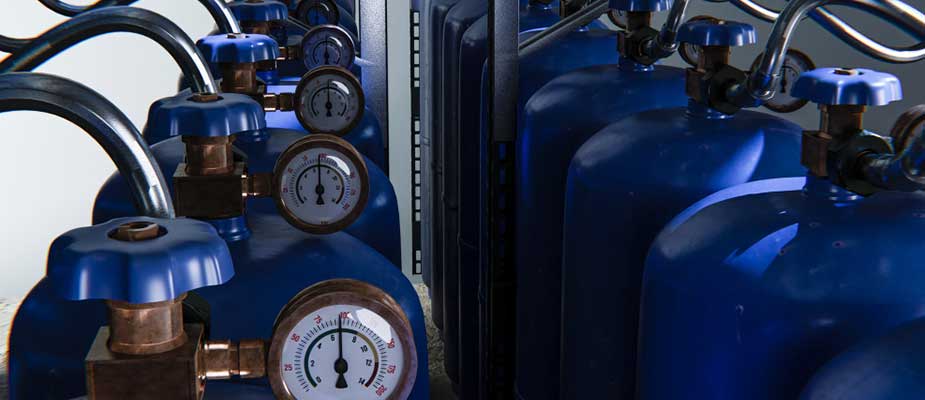
A hydrogen gas cylinder cascade is an interconnected bank of hydrogen gas cylinders that have been arranged in a staged manner (high pressure, medium pressure and low pressure). These cylinders are linked together with a manifold and pressure regulators for maximising the efficiency of hydrogen gas use.
To better understand how hydrogen gas cylinder cascades work, consider the following example of three banks of hydrogen gas cylinders:
When gas is drawn from the bank, the gas first from the low-pressure bank flows into the medium-pressure bank before flowing into the high-pressure bank. These stages of use will result in:
The cascading of hydrogen gas cylinders is based on creating a pressure differential. As a result of this pressure differential, the gas will naturally flow from a high-pressure to a low-pressure gas cylinder. Therefore, by using staged banks, the operator can put gas into each of the banks sequentially without having to use an unnecessary amount of compressor cycles.
In addition to the above benefits, the operator will also experience the following benefits when using a hydrogen gas cylinder cascade:
The ability to quickly fill large quantities of hydrogen gas at very high pressures is important in helping meet demand for fast hydrogen vehicle fill-ups at hydrogen refuelling stations. Using a hydrogen gas cylinder cascade allows hydrogen refuelling stations to quickly deliver hydrogen gas without overworking their compressors.
The introduction of hydrogen-powered vehicles by leading automotive manufacturers such as Toyota and Hyundai means that they will need reliable hydrogen infrastructure, including hydrogen gas cylinder cascade systems, to maintain their production.
If you are considering integrating hydrogen refuelling systems into your facility, now is the time to develop intelligent pressure management solutions that will help your operation meet demand.
Gas cylinder hydrotesting is very important to ensure that gas cylinder storage and hydrogen gas cylinder cascade systems operate safely.
Gas cylinder hydrotesting is conducted by filling a gas cylinder with water and applying high pressure to the cylinder to test its basic integrity.
Hydrotesting is usually known as hydrostatic testing, which refers to the process of testing gas cylinders through high-pressure water.
Gas cylinder hydrotesting includes:
Water is nearly incompressible. Hence, in the event of a failure during the testing process, it will release only a small amount of energy compared to a failure in a gas-filled cylinder, thus making hydrotesting much safer than gas-filled cylinders.
Hydrogen cylinders operate under tremendous pressure. Throughout their lifecycle, stresses may have caused:
Because periodic hydrostatic testing is not typically required, these problems remain hidden until they present significant safety risks.
Hydrotesting provides assurances of:
Four agencies have globalised the standard for testing hydrogen gas cylinders: the International Organisation for Standardisation and the United States Department of Transportation
Cylinders are typically tested every three to five years, depending upon the type of cylinder and the regulations where used.
Not performing scheduled hydro-testing could severely impact your business with the following consequences:
Schedule hydro-testing with a qualified gas cylinder testing service now before the normal deterioration of cylinders becomes a safety concern.
Hydrogen embrittlement is one of the most serious problems related to storing hydrogen gas, as it is the diffusion of hydrogen atoms into metals, thus reducing their ductility.
Causes of hydrogen embrittlement:
Modern cylinder manufacturing methods are addressing the problems related to hydrogen embrittlement through various methods:
Monitoring and maintaining composite cylinders is essential; however, the proper handling of composite cylinders is of utmost importance and requires continuous monitoring/maintenance.
In addition to being used as a standard cylinder material, composite cylinders are now being used to replace or augment steel.
Composite cylinders offer the following advantages:
Due to the demand for hydrogen-powered vehicles (such as buses, trucks, and forklifts), manufacturers must follow strict international regulations concerning pressure vessels in the manufacture and periodic hydrotesting of composite cylinders.
This is not just a trend; Hydrogens will change how we store energy, move it around and use it. America’s move to implement a renewable energy system is happening quickly; Hydrogen systems are developing to better connect and integrate renewable energy (e.g. solar, wind) with heavy transportation and grid stabilisation.
As hydrogen gas storage technology and cascade systems become more efficient and safer through ongoing global cooperation between the nations’ governments, private businesses, and research establishments.